Some friends of ours at Tribehouse Artist Collective posted an interview with Gabrielle Papillon and Ambre McLean here. We reposted it here for your electronic convenience.
by Nico Boesten
A few weeks ago I had the pre-show privilege to catch up with indie folk road warrior artists Gabrielle Papillon and Ambre McLean who shared 3 great little secrets about how they survive (& succeed) at being an indie artist:
1. How to book a tour
2. Where to print cheap, short run CDs and
3. How to stay sane on the road when (or if) things don't go as planned.
They played the Streaming Cafe on April 16, 2011 so you can check out their performance(s) out here for Ambre McLean & here for Gabrielle Papillon. Thanks for the interview guys (and by guys I mean gals).
Header

Tuesday, May 24, 2011
Wednesday, May 18, 2011
Fitzsimmons Fascinates Fans!
by Malcolm Petch
You can tell when artists do their music simply because they love doing it. There’s a different vibe to their show, a difference in the way they engage the audience, and definitely a difference in the way they act off-stage and out of the public eye.
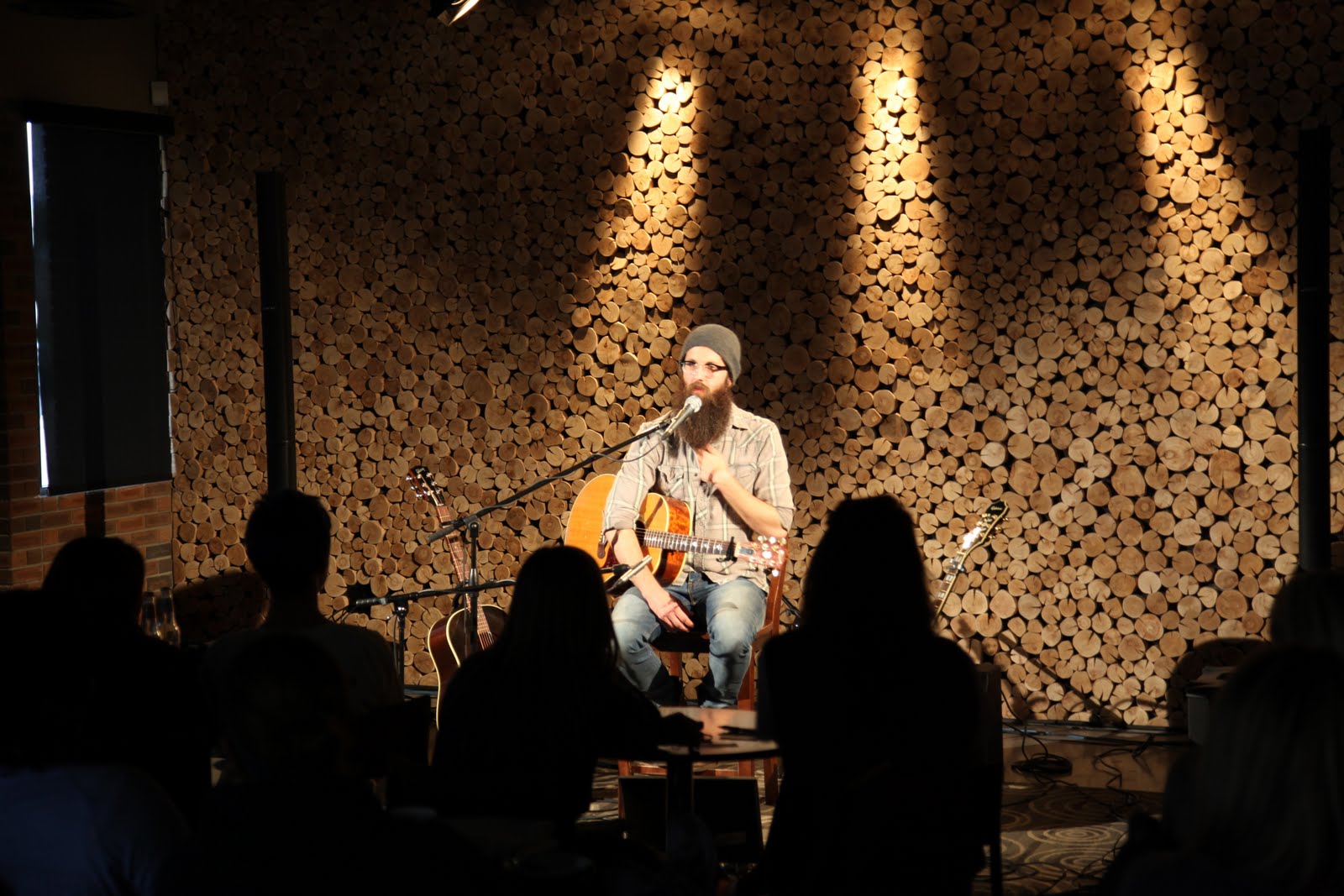
William Fitzsimmons played Streaming Café this past Saturday. We spent a lot of prep time both in try to book him and in getting ready for the show itself – I believe Michael first spoke to Fitzsimmons’ agent back in June 2010, so the show was almost a year in the making. Tickets sold out in 24 hours, to a large percentage of out-of-town purchasers, and the anticipation grew.
 I listened to Fitzsimmons’ newest album a great deal leading up to the show. Other people would hear it in the background and ask, “Hey, who’s this?” Even with its quiet presence, his music has a way of slipping past being unconscious background sound and becoming the thing you’re focused on. His songs are quiet, thoughtful, and based on a lot of psychological areas Fitzsimmons has dealt with in his years as a mental-health therapist.
When it was finally show day, the crew showed up early to make sure everything was set and working before the artist arrived.
Fitzsimmons, in person, was full of dry wit and humour, which is a contrast to the music he writes. We found him very easy to work with, and he was gracious and easy going when sound issues extended the sound-check longer than normal.
In his performance, William chatted easily with the in-house and online crowd (more than 1,200 people watched the show across the globe online, and the café was a sell-out crowd). An online audience member asked Fitzsimmons what he thinks about while he sings, and his answer was laced with pithy side-comments that had everyone laughing. “Because of the type of music I write,” he said, “which is very similar to Kesha and Lady Gaga and things like that [this got the audience chuckling, and throwing out comments], oh, and I’m very similar to Justin Bieber…”. But when the laughter died down and Fitzsimmons spoke his heart, you could tell that everyone appreciated what he had to say.
 “Because my music is personal and kind of evocative,” he said, “it can be a little bit deep and kind of challenging (I think ‘depressing’ is the word I’m looking for). I don’t think it’s proper to sing something that I’m not authentically feeling right at the moment. I feel that that would be manipulating, and just greed, really; just doing it for money or something like that. So whenever I sing a song, I put myself emotionally back into the place I was whenever I first wrote it – and if I can’t do that with a song, then I won’t play that song. That, to me, just seems like the right thing to do. I think anything else would just be dishonest.”
Though he is newly-signed to Nettwerk Records, Fitzsimmons is an established indie artist. And true indie, too: his first two albums were recorded at home between school breaks from his graduate studies (he’s got a Masters in Psychology). His third album was done in a studio, and went to #1 on the iTunes charts for Folk music. Number one on iTunes means more people bought that album than they did any other folk album – pretty good when you paid all the bills yourself and receive all the income from those sales. That obviously played a big role in Nettwerk Records wanting to sign him.

And though he is obviously generating an income from his music, it was clear from Fitzsimmons appearance at Streaming Café that he isn’t into music for the money. When the night ended and everyone clapped and asked for more, William left the stage and stood off to the side out of the lights, asking for the live stream to be turned off. Then he came out and did two or three songs just for the people in the café. He didn’t use a mic, and he walked into the middle of the crowd to play directly for the people who were there.
I liked the way William Fitzsimmons interacted with the crowd in the café. He joked with one young couple who had announced they were planning to use one of his songs at their wedding. He stood in the middle of the room to sing his last number, getting as close to the audience as he could, and he even played a special request number outside in the parking lot to another young couple.
All in all, we truly enjoyed having WF at SC this last Saturday. We’re working hard at getting some quality YouTube vids up so everyone can enjoy the music again, and though it will probably be a long time before Fitzsimmons hits small-town Western Canada again, we’d love to have him at Streaming Café for an encore performance!
You can tell when artists do their music simply because they love doing it. There’s a different vibe to their show, a difference in the way they engage the audience, and definitely a difference in the way they act off-stage and out of the public eye.
William Fitzsimmons played Streaming Café this past Saturday. We spent a lot of prep time both in try to book him and in getting ready for the show itself – I believe Michael first spoke to Fitzsimmons’ agent back in June 2010, so the show was almost a year in the making. Tickets sold out in 24 hours, to a large percentage of out-of-town purchasers, and the anticipation grew.
 I listened to Fitzsimmons’ newest album a great deal leading up to the show. Other people would hear it in the background and ask, “Hey, who’s this?” Even with its quiet presence, his music has a way of slipping past being unconscious background sound and becoming the thing you’re focused on. His songs are quiet, thoughtful, and based on a lot of psychological areas Fitzsimmons has dealt with in his years as a mental-health therapist.
When it was finally show day, the crew showed up early to make sure everything was set and working before the artist arrived.
Fitzsimmons, in person, was full of dry wit and humour, which is a contrast to the music he writes. We found him very easy to work with, and he was gracious and easy going when sound issues extended the sound-check longer than normal.
In his performance, William chatted easily with the in-house and online crowd (more than 1,200 people watched the show across the globe online, and the café was a sell-out crowd). An online audience member asked Fitzsimmons what he thinks about while he sings, and his answer was laced with pithy side-comments that had everyone laughing. “Because of the type of music I write,” he said, “which is very similar to Kesha and Lady Gaga and things like that [this got the audience chuckling, and throwing out comments], oh, and I’m very similar to Justin Bieber…”. But when the laughter died down and Fitzsimmons spoke his heart, you could tell that everyone appreciated what he had to say.
 “Because my music is personal and kind of evocative,” he said, “it can be a little bit deep and kind of challenging (I think ‘depressing’ is the word I’m looking for). I don’t think it’s proper to sing something that I’m not authentically feeling right at the moment. I feel that that would be manipulating, and just greed, really; just doing it for money or something like that. So whenever I sing a song, I put myself emotionally back into the place I was whenever I first wrote it – and if I can’t do that with a song, then I won’t play that song. That, to me, just seems like the right thing to do. I think anything else would just be dishonest.”
Though he is newly-signed to Nettwerk Records, Fitzsimmons is an established indie artist. And true indie, too: his first two albums were recorded at home between school breaks from his graduate studies (he’s got a Masters in Psychology). His third album was done in a studio, and went to #1 on the iTunes charts for Folk music. Number one on iTunes means more people bought that album than they did any other folk album – pretty good when you paid all the bills yourself and receive all the income from those sales. That obviously played a big role in Nettwerk Records wanting to sign him.

And though he is obviously generating an income from his music, it was clear from Fitzsimmons appearance at Streaming Café that he isn’t into music for the money. When the night ended and everyone clapped and asked for more, William left the stage and stood off to the side out of the lights, asking for the live stream to be turned off. Then he came out and did two or three songs just for the people in the café. He didn’t use a mic, and he walked into the middle of the crowd to play directly for the people who were there.
I liked the way William Fitzsimmons interacted with the crowd in the café. He joked with one young couple who had announced they were planning to use one of his songs at their wedding. He stood in the middle of the room to sing his last number, getting as close to the audience as he could, and he even played a special request number outside in the parking lot to another young couple.
All in all, we truly enjoyed having WF at SC this last Saturday. We’re working hard at getting some quality YouTube vids up so everyone can enjoy the music again, and though it will probably be a long time before Fitzsimmons hits small-town Western Canada again, we’d love to have him at Streaming Café for an encore performance!

Wednesday, May 11, 2011
Lottery Grants with CIRAA - C'mon, it's worth a try
Here's a post from our friends at Tribe house (an artist collective). Find out more about them here.
by Nico Boesten

There are a few things that almost every independent artist loves: money, winning the lottery & a good acronym. Like CIRAA.
How about having all of them though. Allow myself to explain myself...
I just found a killer new program that the CIRAA (Canadian Independent Recording Artists' Association) is offering to indie musicians on a lottery basis called the Groundbreaker Grant.
Here's how it works:
You play a gig.
You signup and become a member of CIRAA (free).
You type in a couple of quick details about your gig(s).
20 people will be given a $100 grant (yup, free money) per month.
 You can get up to $1200 this way per year and it takes like 3 minutes to put your info in there. And it's free.
All mind-blowing details here.
SOCAN also has some cool ways for you to make extra money on gigs you've already played but this is a new thing that's being introduced. Last I checked, CIRAA has about 4000 members so your chances of winning are (insert math equation here) pretty good I think. If you win or apply, let us know.
PS: If you don't know who the CIRAA is, it's similar to the CIA except it has nothing to do with spies, guns, black suits, movies, or highly classified operations. But they are both non-profits that are tied in to the government...
(from their site)
CIRAA is Canada's only national non-profit organization dedicated exclusively to Canadian independent recording artists. They are totally into:
Hope you find this helpful. If not, click here for a totally off-topic Sexy Sax Man viral video of the week.
by Nico Boesten

There are a few things that almost every independent artist loves: money, winning the lottery & a good acronym. Like CIRAA.
How about having all of them though. Allow myself to explain myself...
I just found a killer new program that the CIRAA (Canadian Independent Recording Artists' Association) is offering to indie musicians on a lottery basis called the Groundbreaker Grant.
Here's how it works:
You play a gig.
You signup and become a member of CIRAA (free).
You type in a couple of quick details about your gig(s).
20 people will be given a $100 grant (yup, free money) per month.
 You can get up to $1200 this way per year and it takes like 3 minutes to put your info in there. And it's free.
All mind-blowing details here.
SOCAN also has some cool ways for you to make extra money on gigs you've already played but this is a new thing that's being introduced. Last I checked, CIRAA has about 4000 members so your chances of winning are (insert math equation here) pretty good I think. If you win or apply, let us know.
PS: If you don't know who the CIRAA is, it's similar to the CIA except it has nothing to do with spies, guns, black suits, movies, or highly classified operations. But they are both non-profits that are tied in to the government...
(from their site)
CIRAA is Canada's only national non-profit organization dedicated exclusively to Canadian independent recording artists. They are totally into:
- promoting progressive Canadian Content rules that will ensure more airplay for emerging Canadian artists; and
- working to secure increased funding for unsigned artists from government, private radio broadcasters and other players within the music industry infrastructure.
Hope you find this helpful. If not, click here for a totally off-topic Sexy Sax Man viral video of the week.
Tuesday, May 10, 2011
Art Show: Ryan Jickling
 This Friday, May 13th we are happy to be hosting another art show showcasing original works by Ryan Jickling.
Ryan Jickling is a visual artist working mainly as a filmmaker and editor, which by very definition is the job of a storyteller. Ryan’s art also tells a story and takes us through his personal journey. He first started painting in 2006 while in the hospital where he was quarantined with Necrotizing Fasciitis, or flesh-eating disease. He was alone and he was dying. Heavily medicated and in great pain, Ryan awoke one day to find a set of paints had appeared at his bedside.
The first brush strokes to canvas were painted with his left hand because his right hand was literally disappearing, being eaten away by the insidious disease. You will see the passage from his early delirium and his dark and angry works evolve to where his art is today. Canvases that pull the heavens through his surreal vision of reality. Ryan sees art as the something that allows the artist and the viewer to step through into a realm of possibilities.
 The open house art show will run from 5pm to 9pm and will also include music from "Groove Lounge". Local up and coming DJ's spin songs you won't hear on the local radio...ever. Come down, chill and relax.
This will be a great night of local arts, hope to see you there!
Thursday, May 5, 2011
William Fitzsimmons, Gold In The Shadow
by Malcolm Petch
 If the music fitz, wear it.
Few artists get to experience the relatively swift rise to acceptance that has marked the career of William Fitzsimmons. This insightful singer/songwriter is currently on a major-label tour in support of his latest album, Gold In The Shadow, and only a few years ago he was merely recording songs at home during breaks from graduate school.
Just before Christmas last year, Nettwerk Records announced the signing of Fitzsimmons to their label, referring to him as an “indie troubadour” in their press releases. Getting signed – the somewhat mythical and increasingly rare career marker that virtually every aspiring artist hopes for (at least in the early days of their musical vocation) – was no accident for Fitzsimmons: two home-recorded releases and one studio album had propelled him to the top of the indie folk scene, and Nettwerk, by signing him, was simply bringing an accomplished and proven artist into the fold.
There is more to the story than that, of course.
William Fitzsimmons grew up in a home where a multitude of instruments, sing-alongs, and even music-theory instruction were part of the fabric of life. More than a hobby, music was interwoven into the Fitzsimmons family foundation at a core level because William’s parents were both blind. For parents of a little boy growing up and experiencing the world in an entirely different fashion than they were, music was an integral key to building and maintaining a relational bridge that would hold steady over the years. It’s very clear that foundation has been permanently ingrained into William.
Fitzsimmons didn’t plan on being a touring musician, though. He headed off to college and graduate school, earning a Masters Degree in counseling on his way to becoming a mental health therapist, an area in which he had long wanted to be involved. Fitzsimmons went on to serve for many years as a therapist with the severely mentally ill.
During grad school Fitzsimmons picked up music again, writing songs both as a help in preparing himself for work in the psychiatric field and as a means of working through his own psychological questions and issues. During breaks from grad school William started recording these songs, just by himself at his home in Pittsburgh, and in 2005 he released his first compilation as the album Until When We Are Ghosts. The next year he released Goodnight. These albums were in-depth descriptions of both Fitzsimmons' upbringing and his family’s eventual disintegration during his youth, but rather than being dismissed as being ‘non-commercial’ or ‘depressing’, his personal musical catharsis resonated strongly with listeners and met with wide acceptance. Even while he was still working in the psychological field, Fitzsimmons’ songs were spreading broadly and even being featured on TV shows including One Tree Hill, Life of Ryan, 16 and Pregnant, Army Wives, Brothers & Sisters, and others.
But even while he was working on album number two, Goodnight, the deep places he was going in his writing were extracting a costly levy in Fitzsimmons’ personal life, and virtually every part of his day-to-day existence began to fall apart.
In 2008 Fitzsimmons used the springboard of his music’s wider acceptance as a channel to head into the studio for his third album, The Sparrow and the Crow, which ended up being a kind of personal apology to his now ex-wife, describing in detail the happenings surrounding their divorce after nearly ten years of married life. And while the album itself is an account of the darkest period in William’s life, the connection with it felt by listeners everywhere propelled it to the number one spot in the Folk genre on iTunes, and later that year the album was named iTunes Best Folk Album of the year in both the US and Australia.
Musical success and personal adversity were occurring at the same time. Once Sparrow was released, William took a moratorium from songwriting for two years.
In December 2010 Fitzsimmons stepped out of the shadows with his signing to Nettwerk Records. His new album, Gold In the Shadow, was released on March 22 of this year, and the songs on it trace a clean horizon across the troubled landscape painted by his previous three recordings.
“I had reached the point where I was either going to yield to my sicknesses or engage them headlong,” Fitzsimmons says. “In either case, I could no longer continue the way I was.”
Gold In the Shadow is described by Nettwerk as being a musical reflection of the personal resuscitation and psychological renovation which took place for Fitzsimmons in the years following his divorce. The songs are based on a specific set of psycho-pathological disorders from the “Diagnostic and Statistical Manual of Mental Disorders IV”, a text-book Fitzsimmons studied in grad school. Clinical as that may sound, the songs themselves are light and natural, full of hope and healing. Fitzsimmons himself describes the songs as “…a real and long-coming confrontation with personal demons, past mistakes, and the specter of mental illness that has hovered over me for the great majority of my life.” And while his previous three albums have focused on the bareness of relational and personal breakdown, Gold focuses on restoration and change. It’s the type of album that gently sits down beside you and reveals itself as a friend.
William Fitzsimmons is currently on a two-month tour of North America in support of Gold In the Shadow. Most of his tour dates feature the support of his friends, the band Slow Runner, but his appearance at Streaming Café on May 14 will be with the intimacy of a solo performance. The Café should be the perfect setting for this artist: the backdrop of the wood wall, the relaxed natural setting, and the listening-room environment will make for a wonderful evening of reflection and discovery. Tickets are sold-out for the performance, but there is still room online to catch the show. This, truly, is one evening you won’t want to miss. May 14th, 7PM show start time, www.streamingcafe.net
If the music fitz, wear it.Few artists get to experience the relatively swift rise to acceptance that has marked the career of William Fitzsimmons. This insightful singer/songwriter is currently on a major-label tour in support of his latest album, Gold In The Shadow, and only a few years ago he was merely recording songs at home during breaks from graduate school.
Just before Christmas last year, Nettwerk Records announced the signing of Fitzsimmons to their label, referring to him as an “indie troubadour” in their press releases. Getting signed – the somewhat mythical and increasingly rare career marker that virtually every aspiring artist hopes for (at least in the early days of their musical vocation) – was no accident for Fitzsimmons: two home-recorded releases and one studio album had propelled him to the top of the indie folk scene, and Nettwerk, by signing him, was simply bringing an accomplished and proven artist into the fold.
There is more to the story than that, of course.
William Fitzsimmons grew up in a home where a multitude of instruments, sing-alongs, and even music-theory instruction were part of the fabric of life. More than a hobby, music was interwoven into the Fitzsimmons family foundation at a core level because William’s parents were both blind. For parents of a little boy growing up and experiencing the world in an entirely different fashion than they were, music was an integral key to building and maintaining a relational bridge that would hold steady over the years. It’s very clear that foundation has been permanently ingrained into William.
Fitzsimmons didn’t plan on being a touring musician, though. He headed off to college and graduate school, earning a Masters Degree in counseling on his way to becoming a mental health therapist, an area in which he had long wanted to be involved. Fitzsimmons went on to serve for many years as a therapist with the severely mentally ill.
During grad school Fitzsimmons picked up music again, writing songs both as a help in preparing himself for work in the psychiatric field and as a means of working through his own psychological questions and issues. During breaks from grad school William started recording these songs, just by himself at his home in Pittsburgh, and in 2005 he released his first compilation as the album Until When We Are Ghosts. The next year he released Goodnight. These albums were in-depth descriptions of both Fitzsimmons' upbringing and his family’s eventual disintegration during his youth, but rather than being dismissed as being ‘non-commercial’ or ‘depressing’, his personal musical catharsis resonated strongly with listeners and met with wide acceptance. Even while he was still working in the psychological field, Fitzsimmons’ songs were spreading broadly and even being featured on TV shows including One Tree Hill, Life of Ryan, 16 and Pregnant, Army Wives, Brothers & Sisters, and others.
But even while he was working on album number two, Goodnight, the deep places he was going in his writing were extracting a costly levy in Fitzsimmons’ personal life, and virtually every part of his day-to-day existence began to fall apart.
In 2008 Fitzsimmons used the springboard of his music’s wider acceptance as a channel to head into the studio for his third album, The Sparrow and the Crow, which ended up being a kind of personal apology to his now ex-wife, describing in detail the happenings surrounding their divorce after nearly ten years of married life. And while the album itself is an account of the darkest period in William’s life, the connection with it felt by listeners everywhere propelled it to the number one spot in the Folk genre on iTunes, and later that year the album was named iTunes Best Folk Album of the year in both the US and Australia.
Musical success and personal adversity were occurring at the same time. Once Sparrow was released, William took a moratorium from songwriting for two years.
In December 2010 Fitzsimmons stepped out of the shadows with his signing to Nettwerk Records. His new album, Gold In the Shadow, was released on March 22 of this year, and the songs on it trace a clean horizon across the troubled landscape painted by his previous three recordings.
“I had reached the point where I was either going to yield to my sicknesses or engage them headlong,” Fitzsimmons says. “In either case, I could no longer continue the way I was.”
 |
| "Gold In The Shadow"- now available for download! |
William Fitzsimmons is currently on a two-month tour of North America in support of Gold In the Shadow. Most of his tour dates feature the support of his friends, the band Slow Runner, but his appearance at Streaming Café on May 14 will be with the intimacy of a solo performance. The Café should be the perfect setting for this artist: the backdrop of the wood wall, the relaxed natural setting, and the listening-room environment will make for a wonderful evening of reflection and discovery. Tickets are sold-out for the performance, but there is still room online to catch the show. This, truly, is one evening you won’t want to miss. May 14th, 7PM show start time, www.streamingcafe.net
Subscribe to:
Posts (Atom)